 +1-480-241-8198
 +44-7428758945
 +61-1300-332-888
 +91 9811400594
Every interaction a customer has with a brand involves a series of steps that helps them decide on a brand or product. During the stages of customer journey, the customers go from being a target audience to loyal advocates. With the high volume and complexity of data generated, traditional analytics approaches may struggle to give businesses the ability to interpret what customers are doing, why they do it, and what they may do next. This is where AI customer journey analytics has become crucial. It turns scattered signals into direction, helping you derive actionable insights with unprecedented speed and accuracy.
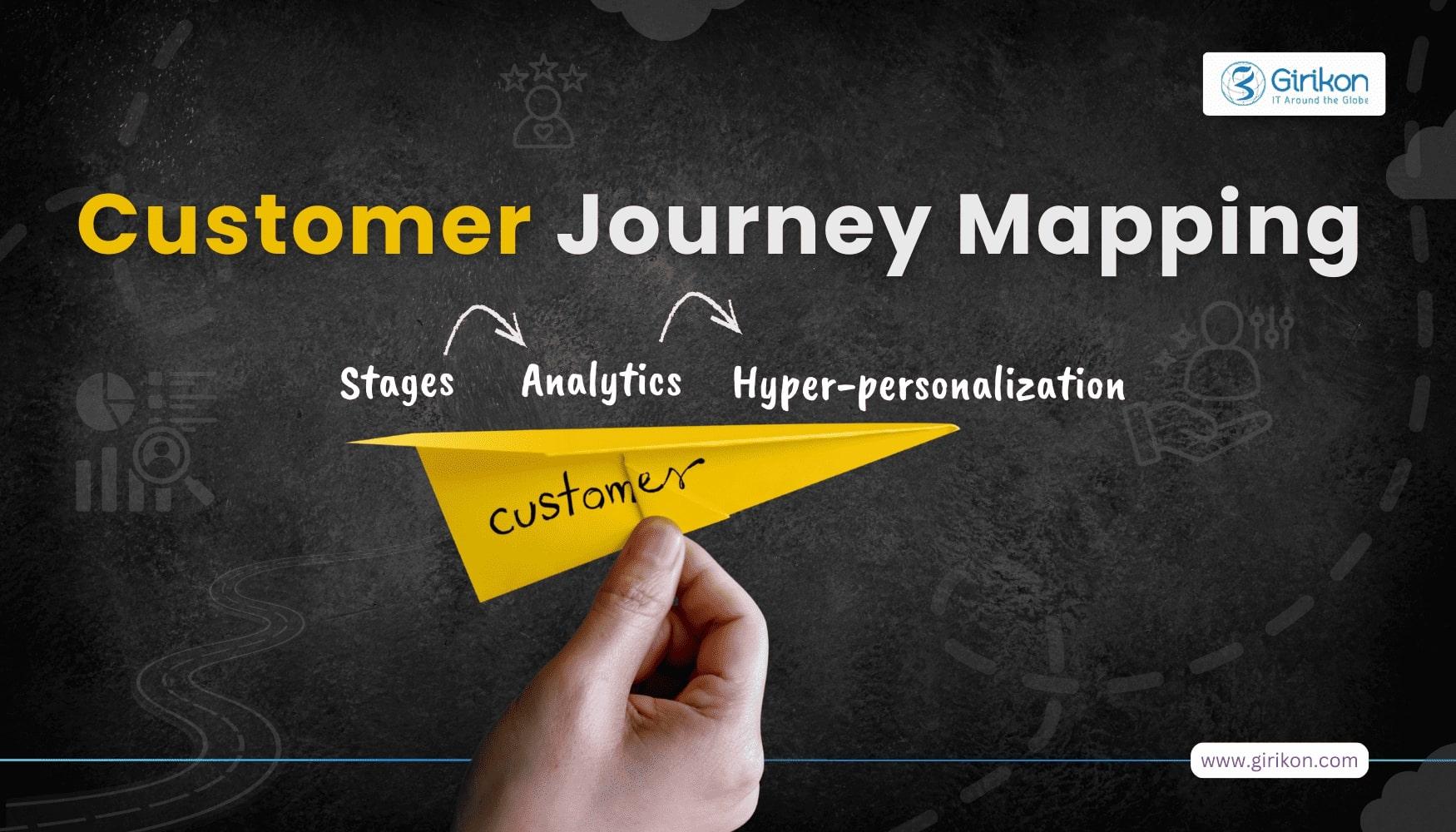
Therefore, in this blog, we’ll explore what is customer journey, the different stages involved, and how intelligence-driven analytics improves personalization. In addition, we’ll also discuss how to develop customer mapping with the help of AI for enhanced customer experience and improve your marketing and remarketing outcomes.
What is a Customer Journey?
A customer journey is the interactions a customer has with your brand and begins way before any official purchase. It covers all the touchpoints of a customer that starts with an initial awareness to post-purchase advocacy, or the renewed interest months later.
Key Stages of Customer Journey
1. Awareness: The customer has a need, and they look for brands to find a possible solution for them.
2. Consideration: They compare alternatives, read reviews, investigate features and decide whether a product is solves their problem.
3. Purchase: The selection is made, and the customer makes a purchase either online or offline, it’s best if they get a friction-less and smooth checkout process.
4. On-boarding: Next step post purchase, which involves customers learning about how to use the product via tutorials, guidance and support, or an initial setup.
5. Use and Engagement: The customer makes frequent use and engagements with services or product and forms an initial impression of usability and stability.
6. Support: Faster and immediate solutions to the customer gets you their loyalty and long-term relationships with them.
7. Loyalty and Advocacy: This is the stage that leads to renewals, referrals or social endorsements from your users, and thus, strengthens your brand image.
What is Customer Journey Mapping?
Customer journey mapping is a method to help businesses visualize how customers interact with your business, while trying to interpret how they think, feel, and react along the way. When you see your brand through a customer’s POV, you can identify gaps and opportunities in the customer experience, ultimately enhancing satisfaction and loyalty. The customer journey mapping is quite useful for businesses to understand what is customer journey & motivations, expectations, and pain points. In addition, it also offers these benefits:
- Predict behavior
- Anticipate needs
- Direct responses effectively
Examples of Journey Maps
One of the examples of customer journey maps is a SaaS app onboarding journey:
- It starts with users’ signing up.
- They receive onboarding prompts and exploring the dashboard
- Moving next to fill the required information to complete setup
- Lastly, trying the core features.
How detailed, clear, and useful the assistance is initially decided whether the user will continue or loses interest. Below we’re discussing the different types of customer journey maps to give you more context into this:
Types of Customer Journey Maps
Current-state map: It shows how customers interact with the brand presently, such as in retail industry, a shopper’s path from search to checkout.
Future-state map: Outlines the ideal journey the company wants to offer, such as a smoother renewal process for subscription users.
Day-in-the-life map: It depicts how customers operate beyond brand touchpoints, such as how a working parent manages daily tasks before choosing a financial product.
Service blueprint: It captures and collages a customer view with supporting internal processes, such as how support teams handle incoming tickets.
What is the Difference Between a Customer Journey Map and a Marketing Funnel?
The core difference between customer journey and a marketing funnel is that while customer journey map shows a customer’s real experiences across touchpoints. A marketing funnel shows a business a structured stage to drive conversion. There are the differences too, these are:
| Factor | Customer Journey Map | Marketing Funnel |
|---|---|---|
| Perspective | Built from the customer’s viewpoint, reflecting emotions, needs, and interactions | Built from the business’s viewpoint, tracking prospects through predefined stages |
| Structure | Non-linear, dynamic, and personalized across multiple touchpoints | Linear and sequential (awareness leads to consideration and then conversion) |
| Focus | Emphasizes customer experience, pain points, and satisfaction | Emphasizes lead progression, conversion rates, and sales outcomes |
| Scope | Covers the entire lifecycle, including post-purchase and advocacy | Primarily ends at purchase or conversion |
| Use Cases | Helps improve customer experience, retention, and loyalty | Helps optimize marketing strategies, lead generation, and sales efficiency |
What is Customer Journey Analytics?
Customer journey analytics is the process to connect different customer identities and interactions across channels, platforms, devices, and time to offer fast, holistic analyses. Traditional analytical systems were proving insufficient since they only presented fragments of the story like clicks, session metrics, or ticket counts, and didn’t produce ‘why’ behind customer actions.
The businesses faced challenges because data is siloed and they don’t have ability to spot patterns across different channels, forcing teams to rely on assumptions that often miss the mark and lead to costly operational errors. This is why the need for AI-powered and advanced custom journey analytics was required. Moreover, did you know that AI-powered personalization in marketing enhances customer satisfaction by 15% to 20% and reduces the cost of service by 20% to 30%.
This is why businesses are relying more on modern analytics, and the data is unified despite being scattered across marketing behavior, product usage, sales touchpoints, and support conversations. Teams get detailed and clear insight into customer touchpoints, critical triggers, and the exact points where drop-offs occur. In addition, they also have a better understanding of what motivates a customer and compels them to push towards an action and where their interest loses.
Therefore, from identifying customers at high risk of churn to suggesting the optimal next-best action, this continuous intelligence injects significant speed and operational precision into your strategy. Real-time analysis is the key differentiator. A subtle hesitation on a pricing page, a repeated product search, or difficulty during the on-boarding process can instantly trigger highly tailored recommendations, ensuring personalization feels authentic and perfectly timed.
Benefits of Hyper-Personalization for Customer Experience
According to IBM, Hyper-personalization is “a business strategy that uses advanced technologies to deliver highly tailored experiences, products or services based on individual customer behavior and preferences.” Businesses using this strategic commitment to adapting customer experiences based on their real-time behavior drives whatever information, suggestion, or experience each customer receives is based on their own interest, likes and preferences.
The idea is to deliver high-value relevance, not high-pressure tactics, along with targeted assistance and contextually valuable suggestions at the precise moment they are needed.
Example of Hyper-Personalization
One of the popular examples of hyper-personalization in recent times is Spotify. The music streaming platform is quite loved for how it uses ML models to offer unique user feeds, and playlists. But is globally loved for its shareable “Spotify Wrapped,” an annual marketing campaign that shows its listeners a compilation of their favourite songs, albums and artists.
Measurable Business Impact of Hyper-personalized Journeys
- Higher Conversion Rates: When messages and recommendations resonate with real time intent, the customer makes decisions with a lot of clarity and assurance.
- Reduced Acquisition Costs: Reduce wasteful impressions through a better-targeted approach, as well as more intelligent routing to add value to each touchpoint.
- Operational Clarity: When teams have the advanced insights, goal and clear strategy, they can focus more on the most impactful interventions instead of managing fragmented data sets.
- Higher Long-term Value: Satisfied customers remain longer, spend more time with you online, and contribute to increased lifetime value across segments.
- Stronger Customer Trust: Customer journeys that are made relevant, thoughtful, and personalized, increase a customer’s trust in both the brand and its promises.
7 Ways Intelligence Elevates Personalization for Businesses
- Detects Actual Customer Intent: These advanced systems can understand a user’s browsing and click behavior as well as the search query. This helps your team in forecasting unspoken requirements. This assists brands to act in real time without it ever seeming obtrusive to the customers.
- Dynamic Behavior Segments: Customer groups don’t have static definitions; they constantly change as habits and interests change. Therefore, communication must stay geared towards the customer’s current, active engagement.
- Predicts Critical Next Steps: The system can predict the likelihood of when a customer will convert, pause or churn, providing the teams with thoughtful and high-impact lead time.
- Tailors Content and Recommendations: Information changes immediately depending on the activity that took place before, so the suggestions sound entirely natural, timely, and integrated with the customer’s immediate context.
- Streamlines the Entire Journey: Comprehensive analysis across multiple customers’ journey reveals what is working best, where the interest levels are stagnant, and where specific system adjustments will bring the best result.
- Links Communication to Current Action: The messages delivered on all channels, including email, push, or in-app, are relevant in the present context of activity of the customer, rather than the information shared last week.
- Swiftly Identify Friction Spots: Customer drop-offs or repeat errors are spotted fast, hence enabling teams to overcome platform or procedure problems before they impact the customer experience.
5 Steps to Implement Intelligence-Driven Journey Analytics and Mapping
So far, we’ve got the idea about how the customer journey goes through changes as a user moves along the funnel. In different ways hyper-personalization ensures the customers receive the experiences and services catered to their personal choices and preferences. Let’s now move on to how to successfully develop an intelligence-driven journey to deliver hyper-personalized experiences to your customer:
Assess Your Data Environment
Begin by understanding where the information about your customers resides in all the tools and the teams you work in and take note of what interactions go unrecorded. This will assist you in knowing how visitors are passing through touchpoints and where the story becomes unclear or fragmented.
Integrate Channel Narrative
Rather than making marketing, product usage and support three different worlds, bringing these insights together in a unified story, it helps you in tracking a person’s movement in a much more natural order. As soon as the journey is represented as a continuous path, priorities are inclined to reveal themselves.
Define Practical Outcome
It’s essential to have one realistic goal before mapping a journey with different objectives. Doing so helps your team focus on nurturing a journey towards one singular goal like improving onboarding or strengthening retention, making it easier to decide whether your efforts are adapting to the way a customer proceeds in the funnel.
Map Real Customer Journey
You must have a clear understanding of where a customer goes through step by step, including points when they feel hesitant, lose interest or require support. Such an honest and clear perspective usually shows why some stages feel slow or confusing to follow, and how customized assistance may make them feel more confident about moving forward.
Test & Learn Iteratively
Once you launch with personalization, it is not the end of your project; treat it as a continuous process. Therefore, implement change wherever needed, take note of customer feedback, and continue to improve your strategy. Gradually, the smaller tweaks create journeys that look more qualitative and oriented towards individual expectations and needs.
Bonus Point:
Choose the right tools: A hyper-personalized strategy for enhanced customer journey is incomplete without selecting the right tools. So, focus on finding the tools that support hyper-personalization, such as marketing automation, easier to set up, and maintain trust and comply with regulations.
Platform and Tools for Improved AI Customer Journey Analytics
Salesforce Data Cloud:
The platform unites data on all points of contact with customers and provides real-time information and predictive marking.
Adobe Experience Platform:
Provides a unified profile and AI predictions on multi-channel experiences hence the mapping is simplified.
Amplitude:
It is a widely used behavioral analytics solution to assist brands in understanding the journeys, product utilization, and conversion paths.
Insider:
With an in-built CDP, it helps marketing teams connect customer data, predict behavior through AI-driven journey and personalization tools.
Segment (Twilio):
It is a customer data infrastructure, which creates a unified source of data and activates insights in tools.
Closing Statement
An enhanced customer experience (CX) makes or breaks your brand’s success. Both advanced analytics with hyper-personalization can help you gain a unified view of how your customer interacts with and experiences your product. It is also useful in assisting you to eliminate any form of friction that they might have and be able to determine what factors can make them engage in a continuous interaction. Therefore, to build better relationships, retention and long-term loyalty you must invest in the customer journey and offer personalized content.
Hence, implement advanced intelligent campaigns throughout the customer lifecycle using reliable Salesforce AI-consulting services and get effective business value and streamlined all customer touchpoints.
About Author

Anjali is a technical content writer and strategist with 9 years of experience, bringing expertise in creation and strategy for IT services, software development, and Salesforce consulting companies. She excels at developing SEO-driven storytelling and technical narratives, and in crafting marketing assets that boost visibility, accelerate sales, and deliver measurable business growth.
Share this post on: