 +1-480-241-8198
 +44-7428758945
 +61-1300-332-888
 +91 9811400594
The advent of artificial intelligence within the Salesforce platform has been extremely fast and transformative. What initially was known as Salesforce Einstein — the platform’s groundbreaking AI capability has now proceeded into a more execution-focused ecosystem with Agentforce. For organizations that have trusted Einstein for automation and forecast-driven intelligence, this shift goes simply beyond rebranding. Rather, it marks a shift toward self-operating, smart processes capable of executing tasks instead of simply offering recommendations.
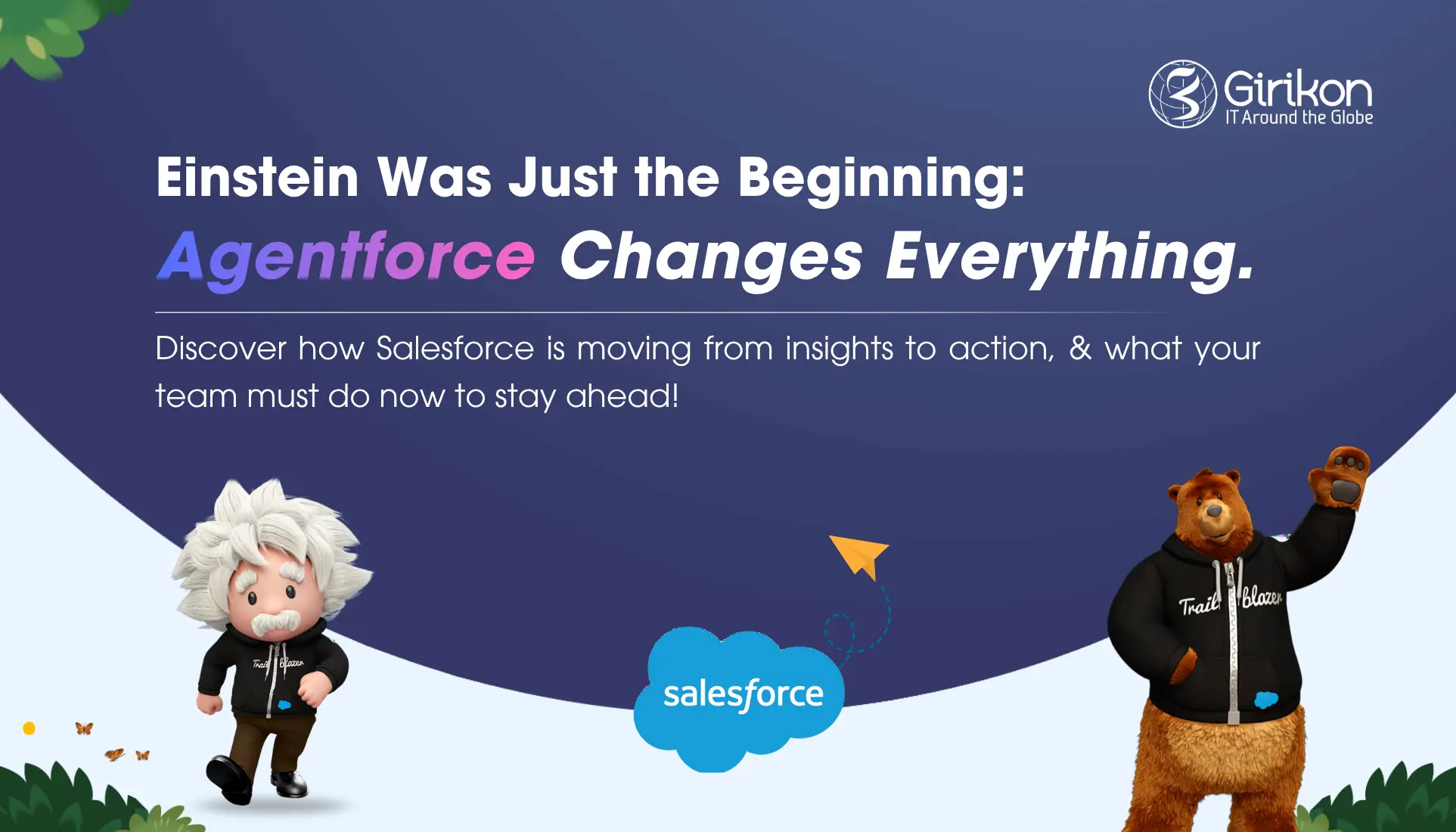
For customers of Salesforce, especially in data-heavy industries – understanding this shift is crucial to remain competitive. This article explores what the shift from Einstein copilot to Agentforce migration involves, why it matters, and how organizations can efficiently prepare for their next move.
From Insight to Intelligence: Einstein’s Impact on Salesforce AI
When Salesforce announced Salesforce Einstein, it represented the start of AI embedded into CRM platforms. Einstein enabled organizations to assess humongous volumes of data, deliver forecast-driven intelligence, automate routine processes, and strengthen analytics-driven recommendations. From lead scoring to opportunity intelligence, it brought AI into the hands of business users without requiring advanced technical skills. However, despite its capabilities, Einstein functioned as advisory layer – offering recommendations without the ability to act independently.
From Einstein to Salesforce: What Does this Shift Mean?
The shift from Einstein to Agentforce isn’t just a technical upgrade. It signifies a significant shift in how businesses use AI. By shifting from data-backed assistance to execution-focused capabilities, organizations can present new levels of efficiency, scalability and flexibility. Businesses that hold this evolution can obtain the following benefits:
Faster Decision-making: Agentforce accelerates decision-making by bridging the gap between insight and execution. Rather than relying on manual involvement, AI agents can instantly rely in real time.
Enhanced Operational Efficiency: This can be attained using automation to manage intricate processes with uniformity. By reducing dependence on manual processes, organizations reduce the risk of glitches while augmenting productivity. This augments teams to focus on crucial tasks and finally initiate optimal outcomes with heightened precision and efficiency.
Enhanced Customer Experience: It is achieved through AI agents that offer tailored exchanges, resolution queries competently, and handle processes with speed. By replying in real time and comprehending client needs more efficiently, organizations can offer consistent, seamless and highly receptive services that enhance satisfaction, appointment, and sustainable customer loyalty.
Scalability: It becomes hassle-free with Agentforce – enabling companies to allow operations without a consistent rise in human resources. By systematizing tasks and processes, businesses can manage heightened demand effectively while sustaining performance. This enables companies to scale, augment costs, and sustain efficiency without increasing operational overhead.
Key Difficulties to Consider When Moving From Einstein to Agentforce
While the benefits are significant, shifting to Agentforce introduces operational and strategic challenges that enterprises must plan for:
Change Management
Teams must adjust to associating with autonomous AI agents, which calls for effective training, shift of outlook, and strong cultural alignment across the company.
Data Readiness
Agentforce depends on well-structured data integration to function well. Organizations must invest their time and resources in data cleansing, system integration, and more to remove fragmented data and discrepancies. Quality data allow for desired AI outcomes, hassle-free automation, and automation. This lays the base for successful adoption and sustainable growth of smart workflows.
Governance
In regulated environments, robust governance structure is needed to adopt Agentforce. Organizations must enforce structured policies, oversight mechanisms, and compliance measures to safeguard regulatory obligations, minimize risks, and build confidence while enabling self-governing systems to function ethically within designated limits.
Customization Complexity
Building and rolling out AI agents using Agentforce demands deep insight of operational processes and strategic intent. Organizations must outline use cases, establish structured rules, and ensure AI behavior that aligns with their objectives. This requires associations across cross-functional teams, strategic execution, and ongoing improvements for better business outcomes.
Guidelines for Seamless Shift from Einstein to Agentforce
Start with Impactful Use Cases: Identify scenarios where automation can generate immediate and tangible ROI, including client support, sales function, or lending operations. Focusing on high-impact areas enables companies to demonstrate quick wins, strengthen confidence in AI adoption, and accelerate momentum for scaling Agentforce across the business.
Utilize Existing Einstein Investments: Organizations can unlock greater value by building insights, models and data frameworks created with Salesforce Einstein. Repurposing these elements reduces deployment time, decreases costs and ensures continuity. This offers seamless shift to the platform while fortifying existing AI capabilities.
Focus on Data Quality: Successful Agentforce implementation requires high-quality data. This requires organizations to focus on data precision, consistency, and availability across systems. This includes doing away with silos, regulating formats, and ensuring data integrity. Robust data foundations ensure reliable AI outcomes, augmented automation accuracy, and optimal decision-making across different business functions.
Build Cross-Functional Teams: Successful implementation of Agentforce requires collaboration across teams. These teams bring different viewpoints – ensuring workflows are officially sound and in line with business goals. This method helps develop effective AI-powered functions, accelerates execution, and paves the way for seamless adoption of smart automation strategies across the organization.
Augment Continuously: Agentforce systems should be tracked to analyze performance, accuracy, and occupational impact. Regular augmentations ensure workflows are in line with evolving market conditions and goals. By evaluating outcomes and fine-tuning processes, organizations can optimize efficiency, augment AI performance, and draw value from their venture.
The Path Ahead
As AI evolves within the Salesforce platform, it’s obvious for businesses to expect a shift from supported intellect to fully decision-capable systems that drive outcomes. In the years to come, several trends will offer greater autonomy by empowering AI agents to move beyond task execution to handling complex workflows. This will reduce trust in manual involvement. Apart from this, organizations will witness more connected systems – enabling easy flow of data across the organization while removing fragmented data. In fact, AI will augment human roles rather than replacing them. Organizations that readily adopt this transition early will be better placed to originate, scale, and contest in a progressive digital landscape.
FAQs
What is the difference between Salesforce Einstein and Agentforce in real-world use cases?
Salesforce Einstein primarily functions as an advisory AI layer, analyzing data to deliver predictions, recommendations, and insights that require human action. In contrast, Agentforce introduces execution-driven AI, where autonomous agents can take actions such as resolving customer queries, triggering workflows, or managing processes in real time.
In practical terms, Einstein helps teams decide what to do, while Agentforce can actually do it. This shift is especially valuable in high-volume environments like customer service, financial operations, and sales pipelines, where reducing manual intervention directly improves speed, accuracy, and scalability.
In practical terms, Einstein helps teams decide what to do, while Agentforce can actually do it. This shift is especially valuable in high-volume environments like customer service, financial operations, and sales pipelines, where reducing manual intervention directly improves speed, accuracy, and scalability.
How should enterprises prepare their data and systems before migrating to Agentforce?
Successful adoption of Agentforce depends heavily on data readiness and system integration. Enterprises should begin by auditing their existing Salesforce data architecture—eliminating silos, standardizing formats, and ensuring data accuracy across touchpoints.
Additionally, integrating core systems (CRM, ERP, marketing platforms) is critical to enable AI agents to operate across workflows without friction. Organizations that already use Einstein can accelerate this process by leveraging existing models and datasets, but they must still validate data quality to ensure reliable AI-driven execution.
Without this foundation, autonomous AI systems may produce inconsistent or suboptimal outcomes.
Additionally, integrating core systems (CRM, ERP, marketing platforms) is critical to enable AI agents to operate across workflows without friction. Organizations that already use Einstein can accelerate this process by leveraging existing models and datasets, but they must still validate data quality to ensure reliable AI-driven execution.
Without this foundation, autonomous AI systems may produce inconsistent or suboptimal outcomes.
What are the biggest risks in adopting Agentforce, and how can organizations mitigate them?
The primary risks in adopting Agentforce include governance gaps, change management challenges, and misaligned AI behavior. Since Agentforce enables autonomous execution, organizations must establish clear guardrails, defining rules, permissions, and compliance frameworks to control how AI agents operate.
Equally important is organizational readiness. Teams need training and alignment to trust and effectively collaborate with AI-driven workflows. Starting with high-impact, low-risk use cases—such as customer support automation or internal process optimization—helps build confidence while minimizing disruption.
With the right governance and phased rollout strategy, enterprises can mitigate risks and unlock measurable gains in efficiency, responsiveness, and scalability.
Equally important is organizational readiness. Teams need training and alignment to trust and effectively collaborate with AI-driven workflows. Starting with high-impact, low-risk use cases—such as customer support automation or internal process optimization—helps build confidence while minimizing disruption.
With the right governance and phased rollout strategy, enterprises can mitigate risks and unlock measurable gains in efficiency, responsiveness, and scalability.
About Author

Jaya is a technical content specialist with 14 + years of experience - especially in the B2B space. Her forte lies in changing complex technologies into compelling narratives that educate, engage and drive business growth. Over the years, she has honed her skills of creating all types of marketing copies including white papers, landing pages, thought leadership articles and website copies that support lead generation, brand positioning, and client engagement. She is also passionate about creating content strategies that outline the future of customer engagement. She is currently associated with Girikon as a Content Manager where she heads the Content function.
Share this post on: