 +1-480-241-8198
 +44-7428758945
 +61-1300-332-888
 +91 9811400594
If you’re diving into a machine learning project in 2026, understanding PyTorch vs TensorFlow is pretty much step one, whether you’re quickly prototyping a model or preparing it for scaled production. These two giants dominate the deep learning world, each with its own strengths designed for different workflows.
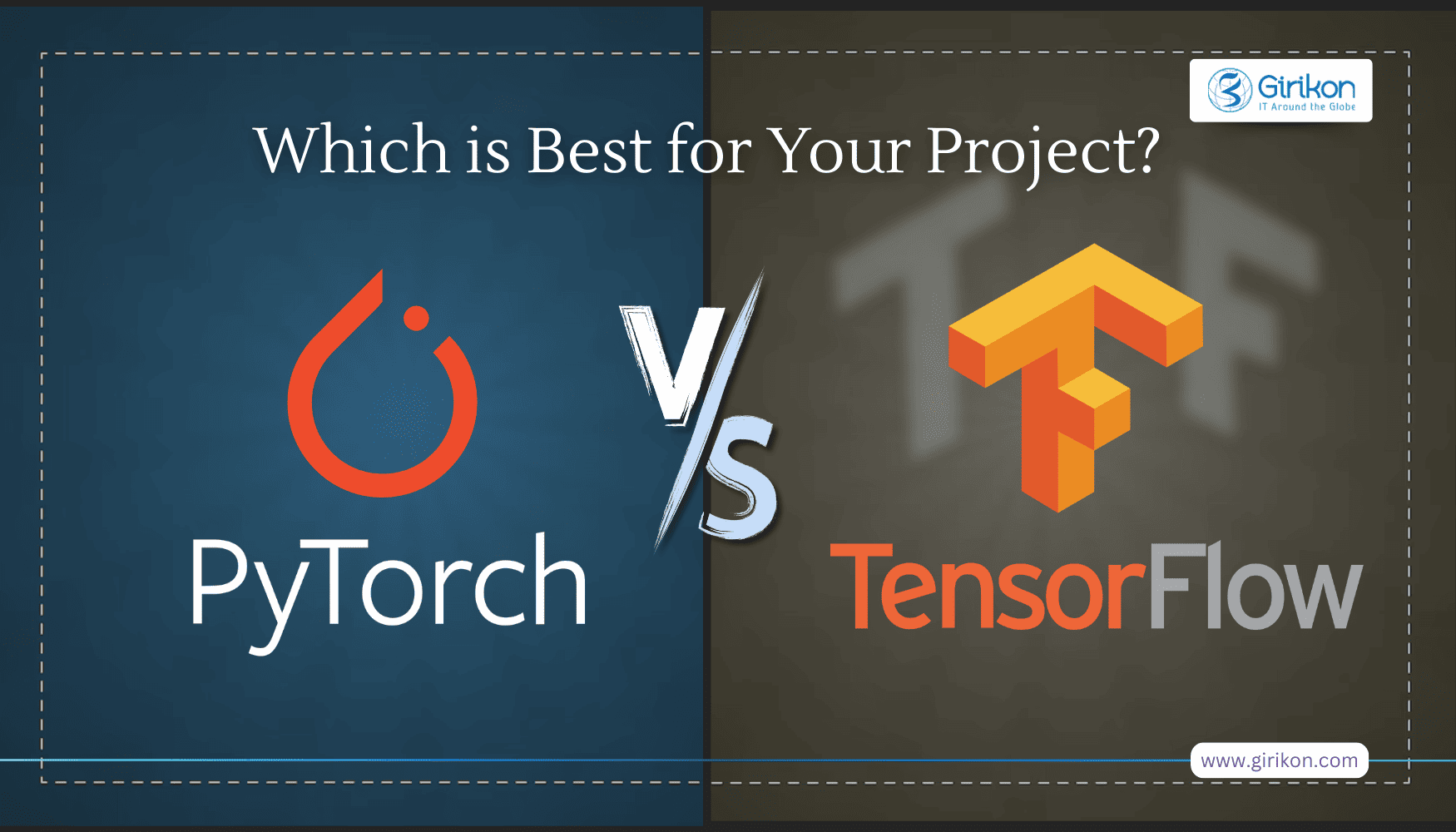
We’ve worked extensively with both frameworks, seen teams switch mid-project, and honestly, choosing the wrong tool can waste weeks. But choosing correctly? Game-changer. Like using the right tool for the right job; you wouldn’t hammer with a screwdriver.
PyTorch and TensorFlow both handle tensors, gradients, and neural networks extremely well, but they shine in different areas. PyTorch feels like natural Python: dynamic, flexible, research-friendly. TensorFlow is structured, scalable, and enterprise-ready.
Stats show PyTorch owning 55%+ of research papers recently, while TensorFlow dominates enterprise production environments. Over 70% of ML professionals use one or both frameworks.
What Are PyTorch and TensorFlow? A Quick Overview
PyTorch
Released by Facebook AI in 2016, PyTorch was built on Torch but redesigned to be extremely Pythonic. It uses dynamic computation graphs, your model builds and adapts as code runs. Perfect for experimentation and flexible modeling. Its NumPy-like syntax makes it beginner-friendly for anyone familiar with Python arrays.
TensorFlow
Launched by Google Brain in 2015, TensorFlow originally relied on static graphs. With TensorFlow 2.x, eager execution became default, making it more flexible. With Keras fully integrated, building models is fast and clean. TensorFlow powers everything from mobile apps to enterprise clusters.
Origins at a Glance
| Framework | Born From | Key Shift in Recent Years |
|---|---|---|
| PyTorch | Facebook AI | TorchScript for production |
| TensorFlow | Google Brain | Eager mode + Keras default |
Both are open-source and free, with no vendor lock-in.
Core Differences: Dynamic vs. Static Mindsets
The real difference comes down to how each framework thinks.
PyTorch (Dynamic / Eager)
- Imperative execution — behaves like regular Python
- Debugging is simple with print statements
- Ideal for research, experimentation, and custom architectures
TensorFlow (Hybrid Static + Eager)
- More declarative — define structure, let TF optimize
- Graph mode provides heavy performance tuning
- Best for scalable deployments and optimized pipelines
Performance: PyTorch 2.x with torch.compile() can reach near 100% GPU utilization, beating TensorFlow’s XLA in several single-GPU tests. TensorFlow, however, shines in distributed multi-GPU and enterprise inference scenarios.
Quick Difference Snapshot
- Graph Style: PyTorch = dynamic; TensorFlow = hybrid
- Debugging: PyTorch easier
- Syntax: PyTorch feels like NumPy; TF uses Keras layers/stacks
- Deployment: TensorFlow wins with Lite, Serving, and JS
- CPU workloads: Roughly equal
Ease of Use: Which Is Better for Beginners?
PyTorch often feels like writing simple Python, intuitive, clean, object-oriented. That’s why students, researchers, and new ML engineers love it.
TensorFlow with Keras is excellent for quick model-building but becomes verbose when deep customization is needed.
| Aspect | PyTorch Edge | TensorFlow Edge |
|---|---|---|
| Beginner Ramp | Intuitive OO Python | Keras simplicity |
| Custom Models | Easier tweaks | More boilerplate |
| Docs/Community | Fast-growing user base | Extremely detailed guides |
Surveys show 60%+ of beginners choose PyTorch first.
Performance and Scalability Showdown
Benchmarks shift every year, but here’s the 2025–2026 trend:
- Single GPU Training: PyTorch faster with torch.compile
- Large-scale inference: TensorFlow leads
- Memory use: PyTorch is lighter for prototyping
- Model export: Both use ONNX, but TF has more native formats
Tip: Always benchmark your own workload.
Real-World Use Cases: Where Each Framework Dominates
Where PyTorch Wins
- Research — 90%+ NeurIPS papers
- Computer vision projects like Detectron2 and Stable Diffusion
- Rapid prototyping
- Teams preferring Pythonic workflow
Where TensorFlow Wins
- Enterprise-scale deployments
- MLOps workflows — TFX, Vertex AI
- Mobile and edge models (TensorFlow Lite)
- Large NLP models (BERT originally built on TF)
By Q3 2025, PyTorch reached 55% production share, narrowing the historical gap.
Common Challenges and Gotchas
PyTorch Limitations
- Production tooling still catching up
- Requires TorchServe or ONNX for deployment
TensorFlow Limitations
- Verbose for custom modeling
- Graph mode quirks still appear in complex workflows
Other Considerations
- Switching is easier now due to similar APIs
- Hardware performance differs across NVIDIA, Apple Silicon, and AMD
Head-to-Head Comparison Table
| Category | PyTorch Strengths | TensorFlow Strengths |
|---|---|---|
| Flexibility | Dynamic graphs, Pythonic | Keras high-level API, graph optimizations |
| Performance | Better GPU utilization in training | Stronger inference scaling |
| Deployment | TorchServe, ONNX | TF Serving, Lite, JS |
| Community | Huge research adoption | Enterprise-grade support |
| Learning Curve | Easier entry | Extensive documentation |
| Best Use Case | Prototyping, research | Production, MLOps |
Which One Should You Choose? A Practical Decision Guide
- Rapid prototyping? Pick PyTorch.
- Enterprise deployment? TensorFlow.
- Python-first team? PyTorch.
- Mobile inference? TensorFlow Lite.
- Hybrid workflow? Use ONNX to bridge both.
40%+ of teams now use both, prototype in PyTorch, deploy in TensorFlow.
Note: This analysis is based on hands-on experience with enterprise ML deployments, benchmarking PyTorch 2.x and TensorFlow 2.x environments on NVIDIA A100/H100 GPUs, and supporting engineering teams transitioning between frameworks for both research and production purposes. Insights come from real-world deployments, debugging sessions, and performance optimization workloads.
Conclusion: The Best Choice Is the Best Fit
There’s no universal winner in the PyTorch vs TensorFlow debate. The “best” framework depends entirely on your project phase, workload type, team skills, and deployment goals. Both tools are powerful, both ecosystems are evolving rapidly, and both can deliver high-quality production ML systems. Choose the one that gets you moving fastest today, you can always pivot later.
FAQs
What’s the difference between PyTorch and TensorFlow?
The key difference is that PyTorch supports dynamic, research-friendly graphs while TensorFlow is good for enterprise scalability with production systems. So, for Pytorch vs Tensorflow 2026 comparison, go for PyTorch when you need faster innovations, TensorFlow, when you need reliable deployment at scale.
Which is better for PyTorch or TensorFlow for AI development?
TensorFlow offers a full-fledged neural network for production of AI, while simplifying builds. PyTorch has user-friendly debugging and scalability capabilities, ideal for state-of-the-art models. So, both shine; the choice depends on experimentation versus deployment priorities as they both come up with leading neural network frameworks for enterprises that need scalable training and deployment.
Which one do you use, TensorFlow or PyTorch in a commercial project?
It depends if your team is equipped to use which deep learning library. But you can use PyTorch for shorter research and prototyping cycles, and you need faster and flexible development. Go for TensorFlow when you need optimized deployment with scalability and enterprise support.
About Author

Indranil is a technology enthusiast with over 25 years of experience in project management, operations, technology and business development. Indranil has led project teams in egovernance, business process re-engineering, product development and worked with Government and Corporate customers. Indranil truly believes in the power of technology to drive productivity and growth for teams and businesses.
Share this post on: