
 +1-480-241-8198
 +44-7428758945
 +61-1300-332-888
 +91 9811400594
What if the technology that you invest in to save time, enhance patient experience, and ease work processes costs much more than expected? For hospitals and healthcare payers — that’s a question worth considering before choosing their next digital solution.
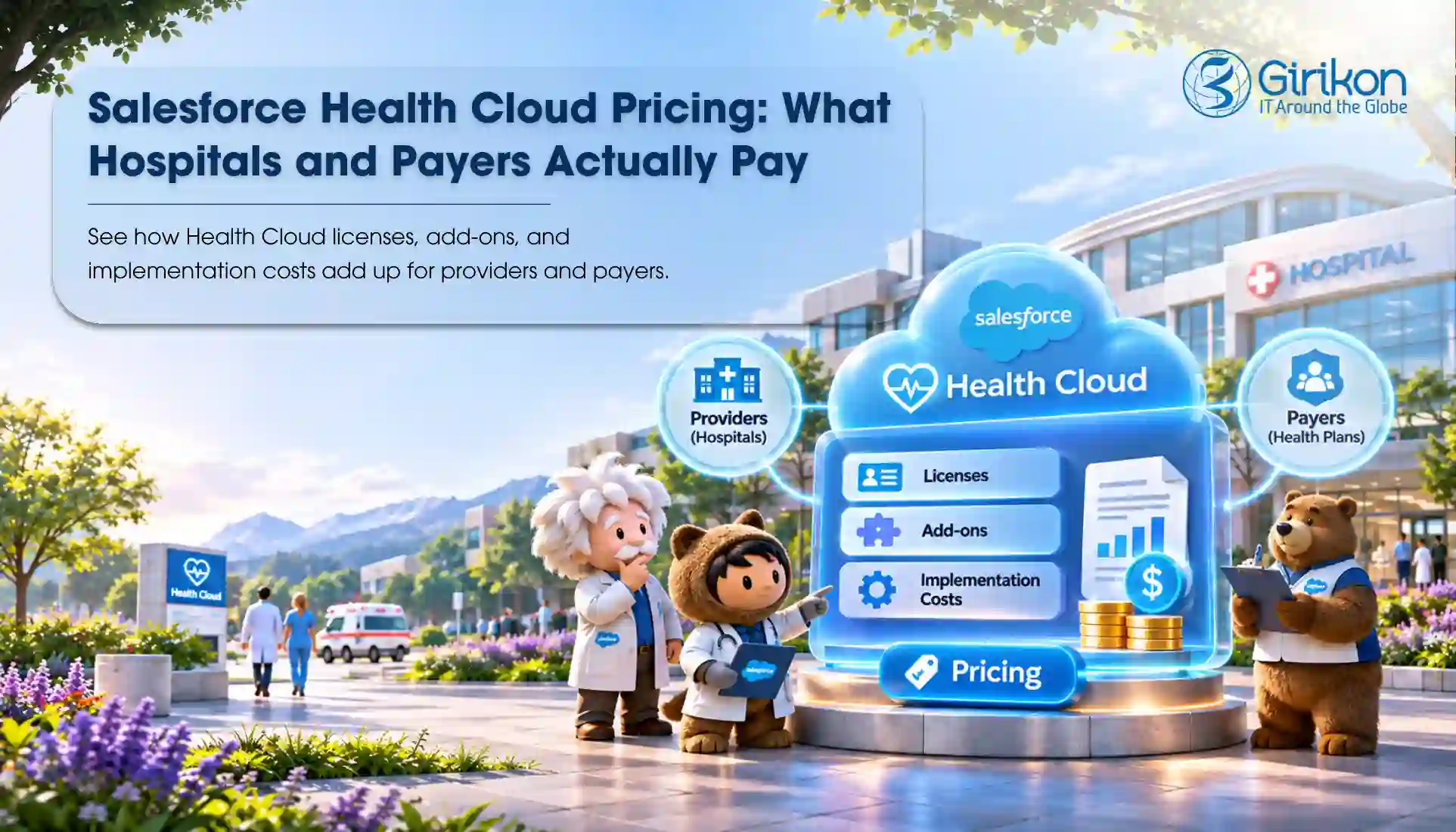
Managing patient information, coordinating care teams, and delivering connected healthcare experiences requires more than disconnected systems and conventional CRM tools. That’s where Salesforce Health Cloud comes in — bringing patient information, healthcare workflows, and teams onto a connected platform.
But how much will the actual process of transformation cost? When understanding Salesforce Health Cloud pricing, we must consider more than just the subscription costs.
Let us examine the costs that hospitals and payers should actually expect before breaking their bank.
How Much Does Salesforce Health Cloud Actually Cost?
When it comes to budgeting for a healthcare CRM, knowing the subscription price is a good place to start. So, how much should you set aside?
Salesforce Health Cloud pricing currently starts at $350 per user/month for the Sales & Service Core edition and goes up to $725 per user/month for the Sales & Service Max edition. All listed prices are in USD and billed annually.
Here’s a quick look at the available pricing plans:
| Health Cloud edition | Monthly cost/user | Annual cost/user |
|---|---|---|
| Sales & Service Core | $350 | $4,200 |
| Sales & Service Advanced | $525 | $6,300 |
| Service Max | $700 | $8,400 |
| Sales Max | $700 | $8,400 |
| Sales & Service Max | $725 | $8,700 |
Swipe to see the full table →
The annual expenses are based on the monthly rates.
An ideal plan will depend on the needs of your organization and the scale of your operations. Remember — these prices represent the license cost, not the complete implementation investment. Your final quote may also vary depending on your contract and additional requirements.
A quick takeaway: A hospital with 50 users choosing the Core edition would spend $210,000 annually on licenses alone. That’s why understanding the complete Health Cloud license cost is essential before making a purchasing decision.
What Does the Salesforce Health Cloud License Cost Include?
Knowing the Salesforce Health Cloud pricing doesn’t mean understanding the price of a monthly subscription alone. What you receive for your payment is equally significant. According to the edition you select, your license may feature healthcare-oriented data models, CRM functionality, productivity tools, analytics, and AI functionalities.
Base Editions and Pricing (USD/User/Month, Annually)
| Edition | Price | What it offers |
|---|---|---|
| Sales & Service Core | $350 | Foundational healthcare CRM capabilities and data models |
| Sales & Service Advanced | $525 | Expanded platform capabilities, data allowances, and AI features |
| Service Max | $700 | Advanced service-focused workflows |
| Sales Max | $700 | Advanced sales-focused capabilities |
| Sales & Service Max | $725 | Combined sales and service capabilities |
Swipe to see the full table →
What Does the License Include?
Depending on which edition you have chosen, Salesforce Health Cloud offers:
Healthcare Data Models:
Pre-designed clinical and insurance data models for patients, providers, care plans, referrals, and all other aspects of healthcare relationship management.
Platform & Productivity Features:
Use of Slack, Tableau, Storage, and Sandbox, depending upon edition entitlements.
AI and Automation:
AI-powered capabilities and Agentforce features, depending on the selected subscription and applicable entitlements.
Support:
Premier Success support, with additional support options available.
Common Add-ons and Related Products (Billed Separately)
Organizations with more specialized requirements may need additional products or licenses, such as:
- Home Health
- Provider Network Management
- Analytics for Health and Life Sciences
- Group Benefits
- Digital Insurance
The pricing and licensing models for these products vary, so they should be verified against the latest Salesforce commercial terms before budgeting.
An important consideration: Your Health Cloud subscription doesn’t automatically cover every implementation requirement. EHR middleware, MuleSoft licenses where applicable, programming, data migration, integration testing, and management might involve further costs.
To gain more insight into how these features help hospitals operate, learn about hospital automation cases on Salesforce Health Cloud.
Additional Costs Hospitals and Payers Must Expect
Subscribing to Salesforce Health Cloud sets things in motion for you, but making it work for your organization may require some extra investments. After all, each hospital and healthcare payer is unique, having its own processes, its systems, and needs that could affect your overall costs.
Additional Expenses for Hospitals
- Configuration and Implementation: Creating customized patient profiles, workflows for care coordination and referral management, etc., based on the daily operations of your hospital.
- Data Migration: Moving all existing data related to — patients, healthcare providers, and clinical history to Health Cloud without losing any vital data or compromising the accuracy of data transfer.
- Development and Customization: Development of customized workflows, dashboards, automation, etc.— based on the requirements of your hospital.
- Training and Change Management: Training physicians, administration, and healthcare providers about the use of the platform.
- Support and Maintenance: Making sure that the system keeps functioning well by performing various tasks such as updates, performance monitoring, troubleshooting, etc.
It is also important for hospitals to think about the way that Health Cloud will integrate into their current health ecosystem. Whether it involves integration of EHR systems or portals, or setting up coordination of workflow processes, the correct approach for implementation can make all the difference. Looking at Salesforce Health Cloud implementation services for hospitals can be helpful.
Additional Expenses for Payers (Insurance Providers & Corporate Employers)
- Integrating Member Data: Integrating information related to policyholders, members, and the insurance process.
- Claim and Authorization Processes: Designing processes for handling the service processes related to claims, including prior authorization and utilization management processes.
- Provider Network Management: Connecting providers with proper documentation of the network.
- Customization & Automation: Tailoring the workflow for processing member inquiries, insurance processes and regular administrative tasks.
- Maintenance: System updates, integrations, access and technical support will all be part of your ongoing maintenance efforts.
In the end — the Salesforce Health Cloud implementation cost depends on your organization’s requirements, the number of users, existing infrastructure, and the level of customization involved.
How Much Does EHR Integration Cost with Salesforce Health Cloud?
The integration of EHR and Salesforce Health Cloud will certainly incur additional costs for your project implementation budget. The cost of integration may vary from $25,000 to $100,000 and above — depending on the service provider and the complexity of data exchange.
EHR Integration Cost Breakdown
| Method of integration | Initial cost | Important factors |
|---|---|---|
| Managed Middleware (Redox, Health Gorilla) | $25,000–$60,000 | Fast installation process, but there are subscription costs involved periodically. |
| Enterprise MuleSoft | $50,000–$100,000 or more | Scalable solution for dealing with complex environments, but it also includes licensing costs. |
| Custom Integration Engine (Mirth Connect, HL7/FHIR) | $40,000–$80,000 | Development costs may be higher, but software costs may be lower. |
Swipe to see the full table →
The cost associated with the EHR integration phase can make up a large portion of the total cost of implementation — the correct strategy to pursue will depend on your current systems, data needs, and future integration requirements.
Please note: The numbers provided above are only rough estimates and do not represent official prices from Salesforce.
Health Cloud vs Service Cloud Pricing: Which Is Better for Healthcare?
One common issue when evaluating Salesforce products is whether to invest in Health Cloud if Service Cloud already offers customer relationship management features and services at a reduced cost.
The reason behind this is the purpose for which each of the two platforms was created. While Service Cloud is built for handling customer service operations, Health Cloud is based on the capabilities of Salesforce but tailored towards the needs of the health sector.
| Comparison | Health Cloud | Service Cloud |
|---|---|---|
| Primary focus | Healthcare CRM | General customer service |
| Data models | Patient, provider, and clinical data | General customer and case data |
| Care coordination | Healthcare-specific capabilities | Requires additional configuration |
| Patient/member management | Healthcare-focused workflows | General service workflows |
| Pricing | Starts at $350/user/month | Core starts at $195/user/month |
Swipe to see the full table →
However, when your organization requires customized healthcare processes, the creation of such processes through customization will lead to higher costs for development and maintenance.
Make your selection according to your organization’s requirements and not the license cost alone.
Health Cloud or Service Cloud? Not Sure Which One Fits Your Budget?
Choosing the wrong platform could mean paying more than you need to — get expert guidance to compare your options and find the right Salesforce solution for your healthcare organization.
Book a Call NowTop 5 Ways You Can Optimize Your Salesforce Health Cloud Investment
Maximizing the benefit of your investment in Salesforce Health Cloud does not necessarily have to mean increasing costs. A few simple steps will help you keep your total Health Cloud license cost low — as well as gain the functionality that is really important for you.
- Selection of the Right Edition: Instead of getting an edition whose features will never be used, opt for a license that meets your requirements.
- Start With Your Functionalities: Begin with your main functionalities like member care, member services, etc., and get other functionalities if necessary.
- Plan EHR Integration: Make sure that you know how much EHR integration is going to cost based on your current software and integration requirements.
- Avoid Customization: Utilize the primary functionalities of Health Cloud first before going for any customizations.
- Promote Usage: Train your employees using the system effectively and make the most out of your licenses.
Final Thoughts: Plan Your Salesforce Health Cloud Investment Wisely
Investing in Salesforce Health Cloud is not only about the selection of the CRM platform, but it is about creating a healthcare ecosystem that will enhance patient experience and optimize the process of treatment. However — prior to implementing this cloud platform, it is essential to evaluate the cost implications associated with it.
As for Salesforce Health Cloud pricing, it varies from $350 per user/month to $725 per user/month. Nevertheless — hospitals and healthcare payers should take into account additional expenses that will be associated with the implementation of the platform, its integration with the EHR system, customization, training and further maintenance.
Ultimately, what is best for your organization will depend on its size, needs, existing setup, and future goals. The right choice of version — along with effective planning can help you achieve cost savings as well as efficient use of the platform.
About Author

Sakshi specializes in creating high-quality, SEO-driven content focused on Salesforce, CRM, and business automation. She writes blogs, landing pages, solution pages, case studies, and thought leadership content that simplifies complex Salesforce concepts, highlights business value, and helps organizations make informed CRM decisions.
Share this post on: