
 +1-480-241-8198
 +44-7428758945
 +61-1300-332-888
 +91 9811400594
Assessing the quality of a customer support experience is as simple as how efficiently problems are resolved. The businesses providing this experience, however, must consider many more aspects. It needs agents with the right information, cases moving through the right processes, and systems that can keep every interaction connected.
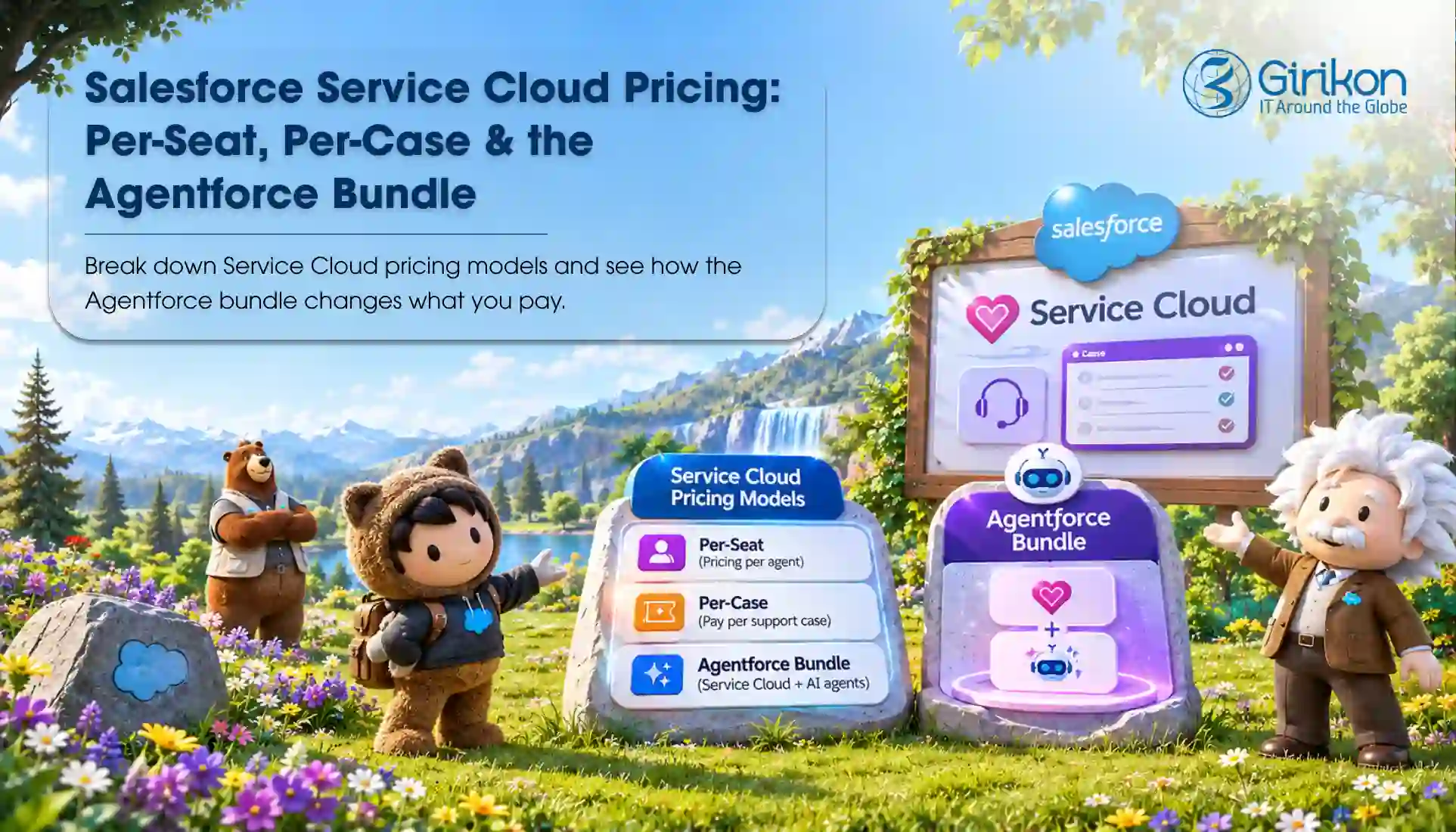
Salesforce Service Cloud brings this activity into a connected environment, giving service teams the tools to manage the work behind every interaction. Yet, putting all these capabilities under one roof comes with commercial consideration of its own. Salesforce Service Cloud pricing is influenced by more than just the number of users who have access to the system. With different types of licensing, advanced features, and the inclusion of the Agentforce package, the value of the subscription has to go beyond it.
Understanding the Commercial Structure Behind Service Cloud
Service Cloud is not one product with one price. It is a license for people, a pool of credits for AI, and a set of extras for everything around them.
The people layer is a monthly fee per user, billed annually. The AI layer is consumption. Salesforce sells it as Flex Credits, a prepaid pool where a standard Agentforce action uses 20 credits and credits list at $500 per 100,000. That makes one action $0.10. A voice action costs 30 credits, which works out to $0.15. Unspent credits are not added to the next billing period. The extra items include sandboxes, support plans, telephony, and implementation. They rarely appear in the first quote and almost always appear in year two.
Per-Seat Pricing: What Are You Paying For?
Per-seat pricing is the most predictable component of the Service Cloud price quote. A single named user requires only one monthly charge, regardless of how many cases they close. The per-seat pricing ladder begins at $25/user/month for Starter Suite and tops off at $550/user/month for Max. In between are the Service Cloud license types, which determine the agent’s toolbox, with increasing depth in routing, knowledge, and reporting. A few bot and knowledge authoring options add per-user fees on some tiers, which makes the feature grid worth checking before signing.
The Service Cloud vs Sales Cloud cost question has a short answer on price: Core, Advanced, and Max list at $195, $395, and $550 for both clouds. The longer answer sits in the surrounding build. Service needs knowledge and channels, sales needs forecasting and quoting, and each adds its own cost.
Then count the people who actually work cases. Seats held by someone who only reads dashboards are usually the easiest saving on the quote.
Per-Case Pricing: Is Salesforce Charging You for Every Ticket?
Not exactly. If a human agent handles a case in Service Cloud, the cost is covered by their existing user license. Open a million cases, and the seat price does not move.
The per-case meter belongs to the AI agent, and Salesforce sells it three ways:
Flex Credits:
Standard actions cost $0.10 each, while voice actions are priced at $0.15.
Per conversation:
$2 for every 24 hours of conversation.
Outcome-based:
$2 per resolved case.
Flex Credits and the older per-conversation model run in parallel, and an organization picks one. The cheaper choice depends on how many steps your agent takes. Take 10,000 conversations a month at five actions each. Flex Credits cost $5,000. The per-conversation rate costs $20,000. The two meet at about 20 actions per chat, or 13 per voice call. Beyond that, the flat $2 wins.
Deflection means the agent resolves the case and nobody else steps in. The case deflection ROI follows from two figures: the agent’s cost per resolved case, roughly $0.50 to $3.33 depending on actions per chat and resolution rate, and your fully loaded cost per human-handled case. Escalations break the math. A chat that burns 25 actions and still reaches a person has billed you for the attempt, and someone still had to finish the job. Measure resolved cases, not conversations started.
What Does the Agentforce Bundle Change?
Until September 2026, you purchased the seat and bolted AI on top of it. An Enterprise seat priced at $175, plus the $125 Agentforce add-on, totaled $300 per user. That is not a like-for-like swap, since the add-on was per user and the credits are pooled. The bundle changes where the money goes. Each new edition packs in Slack, Tableau Next analytics, Premier Success support, and a yearly pool of credits. Core costs $195 and carries 500,000 credits. Advanced costs $395 and carries 1 million. Max costs $550 and carries 2.75 million.
Two factors put this into a different perspective. The allowance is per organization, not per user, so adding seats adds no credits. Also, 500,000 credits translate to 25,000 actions, which can be broken down into 5,000 conversations, with each conversation taking 5 actions. In other words, at 10,000 conversations a month, your team will burn through 500,000 credits in approximately two weeks. Past the allowance, every action bills at the standard rate.
The bundle does remove some old bills. Premier Success used to cost roughly 30 percent of net license fees, and Advanced includes a Full Copy sandbox that Core charges extra for. So here is a take on Salesforce Service Cloud pricing under the new structure: treat Core’s allowance as a trial, not a budget, and price the overage before you sign.
Service Cloud Edition Comparison: Where Does the Money Go?
Salesforce now lists five pricing tiers for service teams, billed annually. The headline price is easy to compare. What each tier commits you to, in credits and bundled tools, is where budgets drift.
| Edition | Starting price per user per month | Commercial positioning |
|---|---|---|
| Starter Suite | $25 | Small teams that need basic case capture and email replies without much setup. |
| Pro Suite | $100 | Growing teams that want routing, queues, and escalation rules in a simple package. |
| Core | $195 | The Enterprise successor, bundling 500,000 credits with Slack Business+, Tableau Next, and Premier Success. |
| Advanced | $395 | Replaces Unlimited; 1 million credits and a Full Copy sandbox for heavier customization. |
| Max | $550 | Replaces Agentforce 1; 2.75 million credits for large teams running agents at volume. |
Swipe to see the full table →
The Costs Beyond the Subscription
The seat rate is the number everyone quotes. These lines decide what Salesforce Service Cloud pricing feels like in year two:
Overage credits:
Every action past the allowance bills at the standard rate, and Data Cloud (Data 360) usage draws from the same pool as Agentforce.
Sandboxes:
Full Copy comes with Advanced. Core charges roughly 30 percent of net license fees for one.
Voice and telephony:
A voice action costs 30 credits, and the carrier invoices call minutes on its own.
Implementation:
Integration work, knowledge article clean-up, and partner time rarely feature in the opening quote.
Renewal timing:
Existing legacy pricing continues until renewal, when the new editions take over.
Conclusion
A renewal quote looks different once it carries real numbers. One queue’s monthly conversations, multiplied by the actions an agent takes in each, give you the credit usage. Add the seats that genuinely work cases and you have the figures Salesforce Service Cloud pricing actually depends on. Bring those to the edition conversation. Our team is available to review the quote line by line before you sign.
About Author

Akanksha is a technical content writer with 3+ years of experience creating content for IT services, software development, and Salesforce consulting companies. She specializes in SEO-focused content, technical storytelling, and marketing assets that drive visibility, engagement, and business growth.
Share this post on: