 +1-480-241-8198
 +44-7428758945
 +61-1300-332-888
 +91 9811400594
Salesforce marketing automation in today’s era is driven by AI-powered campaign creation, connected client data, and made to tailor client interactions. Today, with the advent of Marketing Cloud Next, organizations are assessing whether their current Marketing Cloud infrastructure should progress toward the modern marketing architecture of Salesforce.
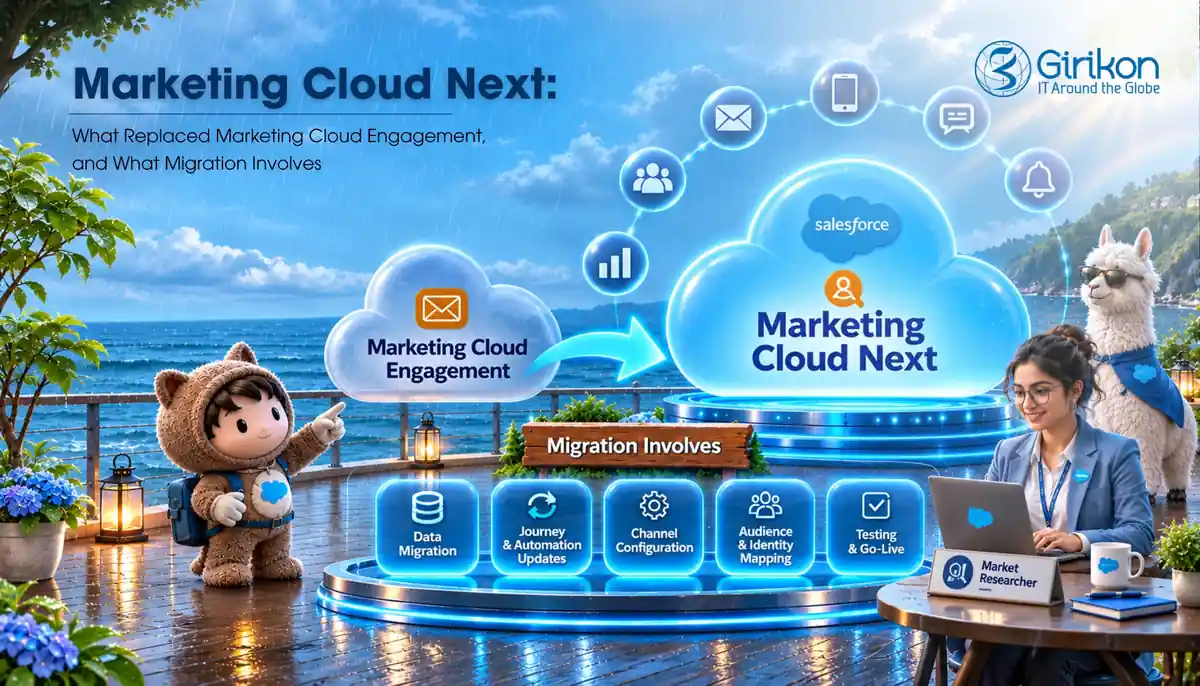
However, one thing is clear that Marketing Cloud Next hasn’t replaced Marketing Cloud Engagement – announcing an instant product retirement. Though, Salesforce has introduced Marketing Cloud Next as its modern marketing technology platform that is native to Salesforce, it continues to support Marketing Cloud Engagement.
It’s crucial for organizations to understand the difference between the two platforms, their pricing structures, and the existing marketing cloud journey path to plan their long-term marketing technology investments.
All You Need to Know About Marketing Cloud Next
Announced in June 2025, Marketing Cloud Next is Salesforce’s innovative marketing solution. Built directly on the Salesforce platform, it is designed to support more tailored and interactive customer experiences by combining marketing automation, CRM capabilities, Agentforce and client data. Unlike legacy marketing systems that function discretely from CRM, Marketing Cloud Next is designed to link marketing activities strongly with all the cloud platforms of Salesforce.
Some of its capabilities include:
- Agentforce Campaign Creation: Create briefs for campaign, audiences, messaging, and campaign road map seeking AI assistance.
- Multi-channel journeys: Coordinate marketing interactions across supported channels.
- Data Cloud integration: Use integrated customer profiles and data-powered audience breakdown.
- Conversational engagement: Support two-way client conversations via channels such as WhatsApp and SMS, based on edition and configuration.
- Personalization: Generate content and recommendation based on customer context.
- Marketing Automation: orchestrate customer experiences and streamline operations using Salesforce Flow.
Marketing Cloud Next vs Engagement: Understanding the Difference
The distinction between the two platforms is mostly architectural instead of just a change in product naming.
Platform comparison
| Capability | Marketing Cloud Engagement | Marketing Cloud Next |
|---|---|---|
| Architecture | Separate marketing platform | Native Salesforce platform |
| Data Foundation | Data Extensions and Contact Builder | Salesforce CRM and Data cloud |
| Journey Automation | Journey Builder | Salesforce Flow |
| Marketing Automation | Automation Studio | Flow-based orchestration |
| Content Creation | Content builder | Salesforce-native content experiences |
| CRM Integration | Marketing cloud | Native platform integration |
| AI capabilities | Existing AI features and newer integrations | Agentforce-centric workflows |
| Customer Records | Subscribers and contact key | Salesforce leads, contacts, and unified individuals |
Marketing Cloud Engagement is suitable for organizations handling complex email programs, advanced Journey Builder workflows, and more. Marketing Cloud Next, on the other hand offers a different approach for organizations seeking fortified CRM integration, AI-powered marketing execution and more.
What replaced Salesforce Marketing Cloud?
The legacy Salesforce Marketing Cloud platform – commonly labelled as Marketing Cloud Engagement coexists with Marketing Cloud Next, which is Salesforce’s recent marketing architecture. Rather than needing every existing customer to make an immediate switch, both the platforms prefer to exist together.
What Is the Marketing Cloud Migration Path?
For existing customers, Salesforce’s recommended approach is increasingly coexistence and incremental adoption rather than an immediate replacement. Marketing Cloud Engagement+ provides access to Marketing Cloud Next capabilities while retaining the existing Engagement environment.
The marketing cloud migration path involves the following stages:
- Assess the Existing Marketing Landscape: Before data or campaign migration, organizations should review their existent marketing setup including Automation Studio activities, Journey Builder workflows, Data Extensions, email templates, and more. They should also verify consent records, subscription preferences, APIs, external data sources etc. This evaluation helps recognize which activities should stay in Marketing Cloud Engagement, and which can shift to Marketing Cloud Next.
- Connect Marketing Cloud Engagement with Data Cloud: Organizations can orchestrate chosen Data Extensions from Marketing Cloud Engagement with Data Cloud to present existing marketing data accessible for subdivision, reporting, and Flow-based workflows. This enables businesses to use their current data while slowly adopting Marketing Cloud Next. Salesforce also supports slated data synchronization. This helps existing Engagement integrations remain working while the synchronized data maintains recent marketing processes.
- Introduce Salesforce Flow and Connected Journeys: Marketing Cloud Next allows businesses to link existing Engagement journeys with Salesforce Flow. So, when a customer accomplishes an onboarding drive in Engagement, Data Cloud can initiate a Flow to commence the next interaction. This ties marketing activities with sales opportunities, client lifecycle events and service requests without restoring every existing journey.
Marketing Cloud Next Pricing: What Can Businesses Expect?
Marketing Cloud Next pricing relies on the edition opted for, messaging requests, size of the organization, and extra capabilities. Salesforce lists the following indicatory prices:
| Edition | Pricing/month or Org |
|---|---|
| Growth | $1500 |
| Advanced | $ 3250 |
The ‘Growth’ edition supports campaign creation, core marketing automation, and multi-channel journeys. The ‘Advanced’ edition adds expertise such as path experimentation and two-way SMS and WhatsApp interactions.
For existing customers of Marketing Cloud Engagement, the Engagement+ pricing structure provides a different route:
| Edition | Price/month or org |
|---|---|
| Pro+ | $2000 |
| Corporate+ | $5500 |
| Enterprise+ | $30,000 |
These packages retain the capabilities of the Engagement platform while providing access to Marketing Cloud Next. The features included, messaging budgets, and access to Growth or Advanced differ by edition.
Pricing may vary w.r.t additional Data Cloud consumption, messaging credits, or other capabilities that may impact the overall investment. Organizations must discus their commercial terms with Salesforce before budgetary planning.
Should Businesses Make an Immediate Shift to ‘Salesforce Marketing Next’?
Marketing Cloud Next is the right fitment for businesses looking to amalgamate marketing data with CRM data, use AI for creating campaigns, amalgamate customer journeys with sales and service processes while delivering tailor-made experiences. However, companies with significant investments in Marketing Cloud Engagement should first assess their existent investments, and workflows. Transitioning to Marketing Cloud Next is more than a software upgrade; it needs careful planning of data, processes, and incorporations.
Final Words:
Salesforce has launched the advanced ‘Marketing Cloud Next’ platform with a vision for unified AI-powered marketing. However, this doesn’t mark the retirement of the ‘Marketing Cloud Engagement’. Rather businesses can leverage the best of both worlds. A practical migration strategy involves assessing recent investments, unifying customer data, presenting Flow-based automation, and slowly picking up new capabilities. When evaluating Marketing Cloud Next vs Engagement, businesses should deliberate their long-term goals, platform readiness, integration readiness and expected business value to upgrade customer engagement without interrupting existing campaigns.
About Author

Jaya is a technical content specialist with 14 + years of experience - especially in the B2B space. Her forte lies in changing complex technologies into compelling narratives that educate, engage and drive business growth. Over the years, she has honed her skills of creating all types of marketing copies including white papers, landing pages, thought leadership articles and website copies that support lead generation, brand positioning, and client engagement. She is also passionate about creating content strategies that outline the future of customer engagement. She is currently associated with Girikon as a Content Manager where she heads the Content function.
Share this post on: